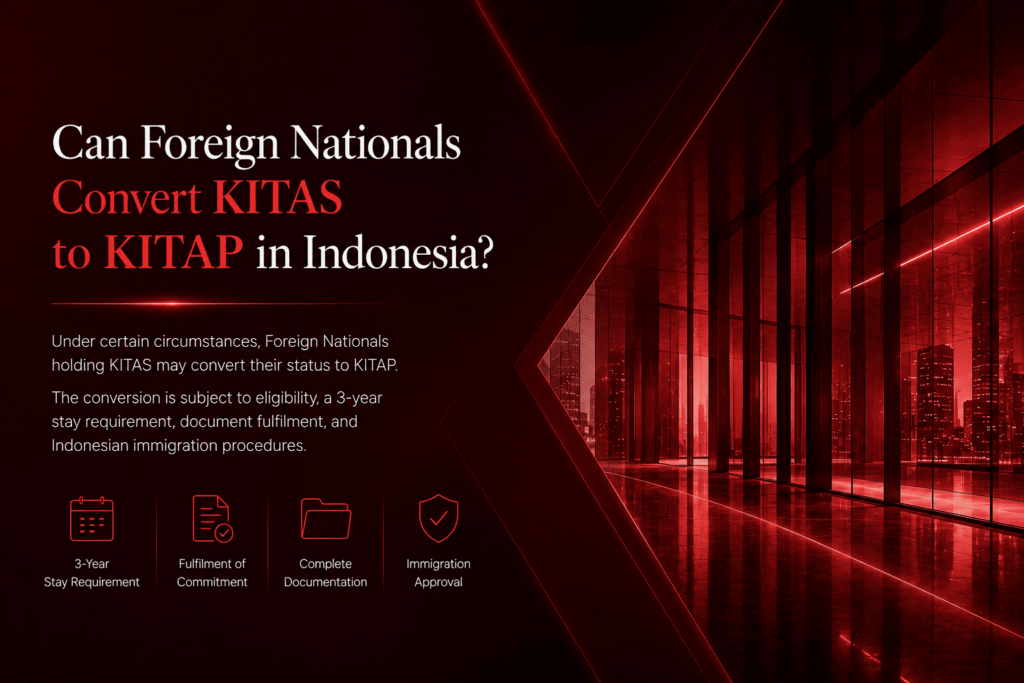
Foreign Nationals holding a Limited Stay Permit (Izin Tinggal Terbatas or ITAS/KITAS) may, under certain circumstances, convert their status to a Permanent Stay Permit (Izin Tinggal Tetap or ITAP/KITAP) in Indonesia.
However, KITAP is not an automatic extension of KITAS. The conversion of status (alih status) may only be carried out by certain categories of Foreign Nationals and remains subject to requirements concerning the period of stay, substantive requirements, supporting documents, and applicable immigration procedures.
The regulatory framework principally refers to Law No. 6 of 2011 on Immigration, as well as the implementing regulations governing visas and Stay Permits.
Who Can Convert KITAS to KITAP?
Under the Indonesian immigration framework, ITAS may be converted into ITAP for Foreign Nationals holding ITAS for certain activities, including:
- working as foreign workers;
- carrying out activities as religious workers;
- making investments;
- family reunification;
- repatriation; and
- Second Home activities, including certain categories such as Foreign Nationals with special expertise, world figures, and elderly Foreign Nationals.
Accordingly, not every KITAS holder automatically qualifies for KITAP. Eligibility must first be assessed based on the purpose and category of the ITAS held.
Three-Year Stay Requirement
For certain categories, particularly foreign workers and ITAS holders in qualifying categories, the conversion of status to KITAP is subject to requirements concerning the period of stay in Indonesia.
In principle, an eligible Foreign National must have resided in Indonesia for at least 3 consecutive years before the ITAS may be converted into ITAP, while taking into account the requirements applicable to each category.
The applicant must also sign a statement of integration as part of the KITAP application.
Accordingly, holding a KITAS for a certain period does not in itself guarantee KITAP approval. Immigration Officers will also assess whether the applicant continues to meet the substantive requirements applicable to the KITAP category being applied for.
When Must the KITAP Application Be Submitted?
The conversion application must be submitted while the existing ITAS remains valid.
Under the applicable procedural framework, the conversion application must be submitted no later than 30 days before the ITAS expires.
This timeframe is important for foreign workers, investors, and Sponsors, as the application should not be postponed until the ITAS expiry date is approaching.
Therefore, an eligibility and document completeness review should ideally be conducted before entering the application period.
Fulfilment of the Commitment Underlying the ITAS
One of the important aspects of converting KITAS to KITAP is the fulfilment of the commitment underlying the previous ITAS.
For categories related to investment or other economic commitments, the Foreign National may be required to provide evidence that such commitment has been realised.
Supporting evidence may include, among others:
- bank statements or evidence of banking transactions;
- amendments to the company’s deed;
- Land and Building Tax documents;
- financial statements;
- corporate tax documents;
- proof of income;
- bonds or securities;
- share ownership; or
- other evidence relevant to the Foreign National’s purpose of stay.
The ITAS conversion may not be processed if the commitment underlying the ITAS has not been fulfilled or cannot be adequately demonstrated.
This is particularly relevant for investor KITAS holders, where the immigration status should remain consistent with the investment structure and the commitment underlying the Stay Permit.
Main Documents for Converting KITAS to KITAP
The application generally requires documents relating to the Foreign National, the existing ITAS, and the Sponsor or Responsible Person.
The main documents may include:
- a valid and still-valid national passport;
- a valid ITAS/KITAS;
- a statement of integration;
- guarantee or sponsorship documents;
- identification and supporting documents of the Sponsor or Responsible Person; and
- the KITAP or other immigration documents of family members where the application is based on family reunification.
Additional documents may be required depending on the KITAP category and the purpose of stay underlying the application.
For applications related to investment, the applicant should also prepare documents evidencing the fulfilment of the relevant investment or economic commitments.
How Does the KITAS to KITAP Conversion Process Work?
The application may be submitted by the Foreign National, Sponsor, or Responsible Person through the immigration system to the Immigration Office or designated Immigration Officer.
In general, the process includes: Submission of the application, Verification by Immigration, Biometric and administrative processing, Submission to the Directorate General of Immigration, Approval or refusal
The Directorate General of Immigration determines whether the application is approved or refused based on the applicable requirements.
If approved, the ITAP will subsequently be issued to the applicant in accordance with the applicable procedures.
What Happens if the KITAP Application Is Refused?
Refusal of an ITAS to ITAP conversion application does not necessarily mean that the Foreign National must immediately leave Indonesia.
Depending on the circumstances and the decision of Immigration, the Foreign National may remain in Indonesia using the existing ITAS until the ITAS expires or may be ordered to leave the territory of Indonesia within the period determined by the Immigration Officer.
Therefore, applicants should continue to monitor the validity of their ITAS during the KITAP application process and should not assume that submitting an application automatically grants a new immigration status.
How TAMA Global Mobility Can Support
TAMA Global Mobility supports Foreign Nationals, employers, multinational companies, and foreign investors with various immigration and Global Mobility matters in Indonesia, including:
- assessment of eligibility for KITAS to KITAP conversion;
- immigration status and document reviews;
- assessment of stay period and eligibility requirements;
- immigration compliance relating to investment and foreign workers;
- preparation and review of supporting documents;
- assistance with the KITAP conversion application process;
- review of Sponsor information and immigration records; and
- strategic advisory on complex immigration and Global Mobility matters.
TAMA Global Mobility helps clients navigate Indonesian immigration requirements through an approach focused on structured immigration, global mobility, and regulatory compliance.
Disclaimer: Here
– – – ||| – – –
TAMA Global Mobility
WhatsApp: +62 821-1015-402
Email: info@tamaglobalmobility.com
For additional insights on Indonesian immigration compliance and global mobility matters, explore our related publications:
Can Foreign Nationals Extend Their Stay Permit in Indonesia Online?
When Immigration Conducts an Inspection: What Can Immigration Officers Ask in Indonesia?
Change of Address in Indonesia: Immigration Reporting Obligations for Foreign Workers (TKA)
Foreign Artists Performing in Indonesia: When Is a Work Permit Required?
Indonesia’s 2026 Draft Manpower Bill: Key Considerations for Employers of Foreign Workers