How can a Foreign National obtain Indonesian citizenship through naturalisation?
Naturalisation or citizenship acquisition is a legal process that allows a Foreign National to obtain the Citizenship of the Republic of Indonesia. This process is different from immigration stay permits such as ITAS or ITAP and does not occur automatically merely because a person has lived in Indonesia for a long period. In general, naturalisation is governed by Law No. 12 of 2006 on Citizenship of the Republic of Indonesia (“Law 12/2006”), Government Regulation No. 2 of 2007, as amended, and Minister of Law and Human Rights Regulation No. 21 of 2020, as amended by Minister of Law and Human Rights Regulation No. 10 of 2024.
1. What Are the Requirements for Naturalisation in Indonesia?
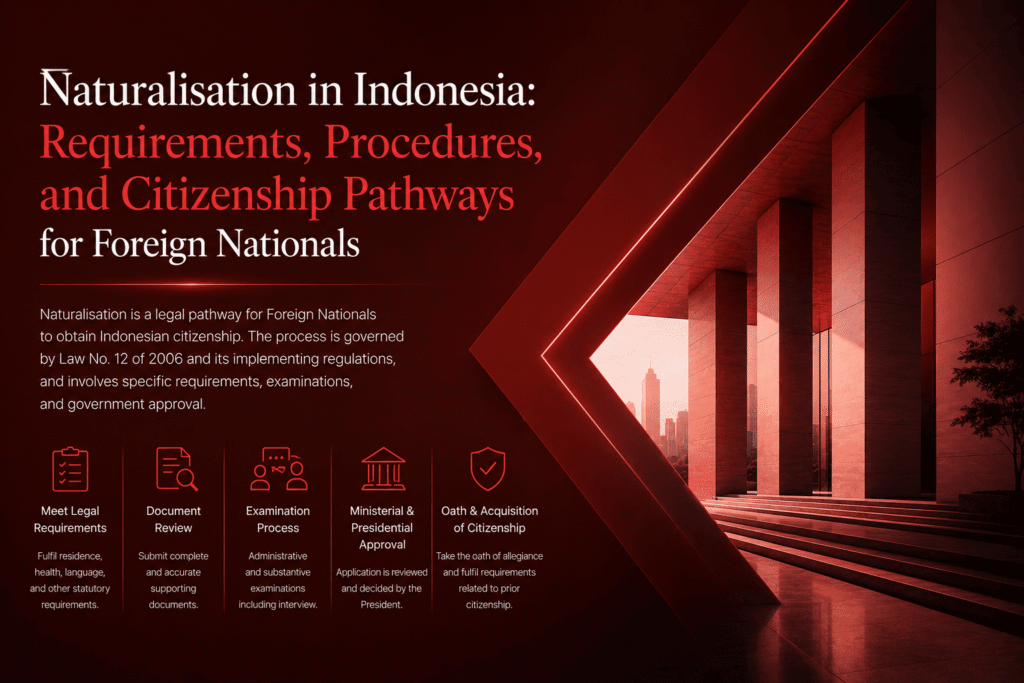
Under Law 12/2006, an applicant for naturalisation must satisfy a number of substantive requirements. The applicant must be at least 18 years old or already married, have resided in Indonesia for at least 5 consecutive years or 10 non-consecutive years, be physically and mentally healthy, be able to speak Indonesian, and acknowledge Pancasila and the 1945 Constitution. The applicant must also never have been sentenced for a criminal offence punishable by imprisonment of one year or more, must have employment and/or a fixed income, and must not hold dual citizenship after acquiring Indonesian citizenship. In addition, the applicant is required to pay the naturalisation fee in accordance with the applicable regulations.
These requirements must be supported by relevant documents, including a birth certificate, marriage or family status documents where applicable, an immigration certificate confirming the period of residence, a health certificate, declarations regarding Indonesian language proficiency and recognition of Pancasila and the 1945 Constitution, a police clearance certificate (SKCK), documents concerning the applicant’s original citizenship, proof of employment and/or income, proof of payment of the naturalisation fee, and other supporting documents. Accordingly, naturalisation is not merely a matter of satisfying the required period of residence, but also involves fulfilling all substantive requirements and providing consistent administrative evidence.
2. How Is the Naturalisation Procedure Carried Out?
An application for naturalisation is submitted in writing in the Indonesian language to the President through the Minister of Law, with the application documents submitted through the Regional Office of the Ministry of Law according to the applicant’s place of residence. At the initial stage, an administrative review is conducted to ensure the completeness and conformity of the documents. If any deficiencies are identified, the application may be returned to the applicant for completion before further processing.
Once the administrative requirements have been declared complete, a substantive examination is conducted by a team established at the Regional Office level. The examination includes verification of the authenticity of the documents and an interview with the applicant, including matters relating to the applicant’s identity, immigration history, integrity, Indonesian language proficiency, and understanding of Pancasila and the 1945 Constitution. If the substantive requirements are satisfied, the application is forwarded to the Minister for consideration before being submitted to the President. The President may subsequently approve or reject the application in accordance with the mechanism stipulated under Law 12/2006.
If the application is approved, the process is not yet fully completed. The applicant must take an oath or pledge of allegiance to the Republic of Indonesia and fulfil the requirements relating to the relinquishment of their foreign citizenship in accordance with the applicable regulations. This reflects the principle that the granting of Indonesian citizenship through naturalisation generally may not result in dual citizenship.
3. Do All Naturalisation Applications Follow the Same Procedure?
Not necessarily. In addition to ordinary naturalisation under Law 12/2006, there are several special pathways with different characteristics and requirements.
A Foreign National who is in a mixed marriage with an Indonesian citizen may acquire Indonesian citizenship through a declaration mechanism under Law 12/2006, subject to the applicable requirements and the principle that the process must not result in dual citizenship.
There is also naturalisation based on services to or the interests of the state under Law 12/2006. Under this mechanism, a Foreign National who is considered to have rendered services to the Republic of Indonesia, or whose acquisition of Indonesian citizenship is considered necessary for reasons of state interest, may be granted Indonesian citizenship by the President after receiving consideration from the House of Representatives, provided that the process does not result in dual citizenship.
In addition, Indonesian citizenship law provides certain mechanisms for children holding dual citizenship who fall within circumstances specified under the applicable laws and regulations. Since each pathway has its own legal basis and procedures, determining the appropriate pathway should be based on the applicant’s citizenship status, family relationship, residence history, and legal circumstances.
What Should Foreign Nationals Consider?
Naturalisation should not be viewed merely as a document submission process. For Foreign Nationals who have lived in Indonesia for a long period, their immigration history, period of residence, family status, employment, income, legal record, and original citizenship are important factors in assessing the eligibility of the application.
In simple terms, the ordinary naturalisation pathway can be understood as:
Meeting the legal requirements → proving the period of residence and other requirements → submitting the application → administrative and substantive examination → Ministerial consideration → Presidential decision → oath/pledge → acquisition of Indonesian citizenship.
Therefore, before submitting an application, it is important to ensure that all substantive requirements have been satisfied and that the applicant’s history and supporting documents can be consistently substantiated.
How TAMA Global Mobility Can Assist
TAMA Global Mobility supports Foreign Nationals, families, employers, multinational companies, and foreign investors in navigating Indonesian immigration and Global Mobility matters, including:
- assessment of naturalisation eligibility and immigration history;
- review of residence periods and immigration records;
- assessment of applicable naturalisation pathways;
- review of supporting documents and statutory requirements;
- coordination of immigration documentation required for citizenship-related processes; and
- strategic advisory on complex immigration, Global Mobility, and regulatory matters.
TAMA Global Mobility assists clients through an approach focused on structured immigration, global mobility, and regulatory compliance.
Disclaimer: Here
– – – ||| – – –
TAMA Global Mobility
WhatsApp: +62 821-1015-402
Email: info@tamaglobalmobility.com
For additional insights on Indonesian immigration compliance and global mobility matters, explore our related publications:
Can Foreign Nationals Convert KITAS to KITAP in Indonesia?
Can Foreign Nationals Extend Their Stay Permit in Indonesia Online?
When Immigration Conducts an Inspection: What Can Immigration Officers Ask in Indonesia?
Change of Address in Indonesia: Immigration Reporting Obligations for Foreign Workers (TKA)
Foreign Artists Performing in Indonesia: When Is a Work Permit Required?